This isn’t really a post I would ever planned to have written but having put off writing it for the last two months, here we are. Please do not continue to read if you are at all squeamish. As those reading this are most likely aware, the rinks re-opened to adult and leisure skaters around twelve weeks ago. Needless to say I was delighted and headed over to Whitley Bay on the very Monday they opened for the first figure only session (hockey skaters sorry but you don’t make for good practice) excited to try out my new skates for the first time.
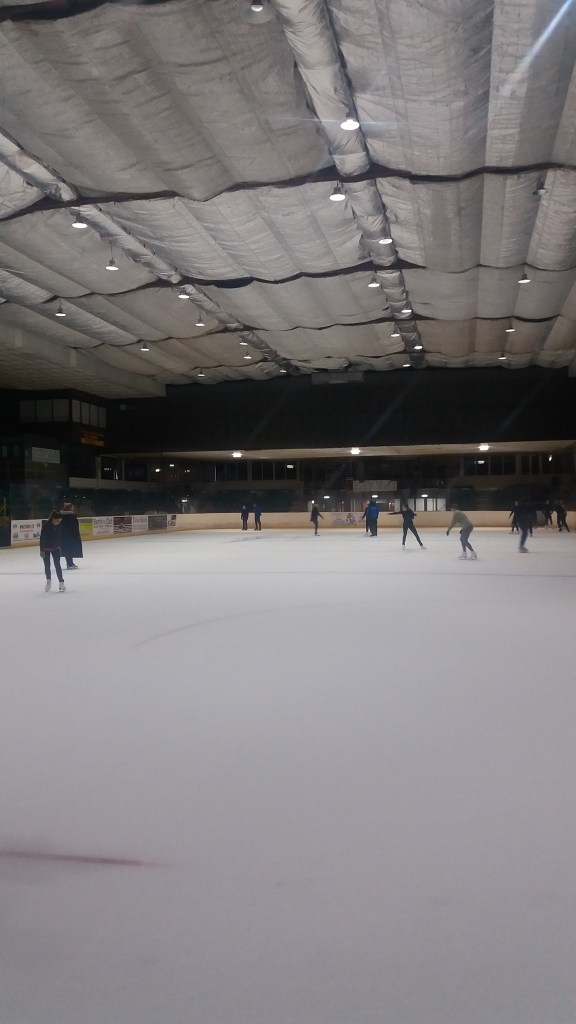
Unsurprisingly the session was quite a bit busier than those mid-day autumn sessions back when I’d been on furlough, though infinitely preferable to the average cram-packed public session. Nervously I stepped back on to the ice and attempted to find my feet again. After a few laps I was approached by one of the coaches who was busy teaching a youngster and given a couple of pointers with regards to twizzels and things I could work on while remaining on two feet. Encouraged I returned the following day and once again remembered just what it was I loved about being out there – that feeling of there being nothing else in the world in that moment, just you and the ice, peace and quiet, lost in no thoughts beyond skating. Determined to make the most of the rink being open I returned to the figure session the following Monday; encouraged and inspired by the more experienced skaters around me I decided to take the plunge and signed up to the learn to skate programme the following day.
At the start of my first group lesson we were asked to skate from one barrier to the other. Having roller skated for many years this was obviously no problem. I was then placed in a group, which I later discovered was group 2 (I’d unknowingly by-passed the beginners class, the rest of the class having already completed their first six-block of classes just before the last lockdown). Understandably there were a number of moves I struggled with but I was pleasantly surprised by how many transferable skills quad skating had given me. In week 2 we reached badge week. I signed up for lessons aiming to reach badge 4 (an arbitrary aim based solely on an awareness that a number of rinks limit patch ice time to those of that level or above) and with what I assumed was a pipe dream of one day being able to do forward crossovers.

As badge testing began, my coach informed me (and another girl who joined that week) that she wasn’t going to insult us with the first couple of badges (that mainly consist of marching on the spot and really checking whether you can stand up on your blades without losing balance) and so the group proceeded with our assessment. To my delight (and shock) we reached badge five, settling only that low(!) because as yet neither of us had mastered the T-stop necessary to proceed any further. Crazily the ‘motorbike’ which for reasons unknown I had no problem whasoever performing, does not appear until badge nine!
The following week the rest of my group moved on and myself and the other newbie were joined by those from group one who had reached badge 4 and bit by bit over the coming weeks we began working on…forward crossovers, backward crossovers, I mastered the t-stop, prep-work for spins, backward twizzels, steps and lunges (lunges, lunges, lunges…we’ll get to those). Every week I’d attend at least one session outside of class and by now these were back to two hours of ice-time, as well as half an hour of group lesson with an hour and a half practice afterwards. Slowly but surely I was getting better. I learnt to fall. Until the day before my first lesson I had only fallen on the ice once, back to my very first time on the ice at twelve years old, when during a youth club trip messing about a friend jokingly gave me a push and I put my hand out and landed on my wrist resulting in a hairline fracture. Ever since I’d been afraid of falling but knew that if I was going to get better I needed to get used to it and learn how to fall safely. Over the coming weeks I fell many times and aside from wet hands, prior to investing in gloves, it felt genuinely liberating. Anyone who’s seen competitive skating knows falling is an occupational hazard.
Lunges. Lunges. Lunges. The first time we were shown lunges I knew I had to do one. They’re actually relatively straightforward but look spectacular. Every trip to the rink I’d lunge away, always with my left leg bent in front and my right leg stretched out behind me, my arms outstretched imagining I was Lilah Fear at the end of Vogue. Knowing that ice dancers travel in all directions I’d attempt to lunge with my left right leg bend, left behind me but on auto pilot do it the other way around or wimp out at the last minute fearful something would go wrong. Fear is natural but it’s very easy to get in your own head and become stuck. I’d been scared of falling for over twenty years and yet I’d conquered that. I’d been terrified about skating backwards, and while I still wasn’t as comfortable with it as going forwards, I was progressing well. So the week before the next badge tests, a couple of minutes before the end of the lesson, having successfully lunged on from my preferred leg when we were invited to try and use the other leg I decided to go for it. About a quarter of the way across I tried but failed. As the midpoint came towards me it was time to just go for it…
What happened next I was not prepared for. Despite having repeatedly stated that I felt like my reluctance was ‘self-preservation’. In a micro second as I straightened my left leg behind me (but crucially for understanding what happened and why – before the blade had made contact with the ice) my entire leg collapsed and buckled over at a right angle. Yes it was every bit as painful as that sounds…and more. The rest of my group by now at the barrier saw me come to an awkward sudden halt. I needed to scream but just before I did so I noticed the two new girls in the corner who the week before had literally needed help just getting on the ice. I looked my group straight in the eye and mumbled “it’s bad, it’s really bad” before collapsing to the ice and letting out the most guttural, animalistic scream. Folk were quick to reach me but when there’s no way of getting up and it’s impossible to move you without causing further pain, removing me from the ice was not going to be straightforward. I remember being very aware of the public skaters on the other side of the cones, as well as the newbies in the corner and while it was impossible not to let out ear-piercing screams I was desperate not to freak them out and tried my best to remain calm.
I’d first dislocated my knee-cap back in 1998 and had done so again at least three or four times between then and 2012 and had known it could happen but this was different. I knew this was different. Back then after the first incident I’d gotten so used to it I would just pop it back in myself. There was no chance that was going to be possible, despite my initial pleas for “someone to put my leg back in” when the rink staff asked what I wanted/needed them to do. The ambulance was called and I was offered a choice. It was going to possibly take a couple of hours for the ambulance to get there (mid-pandemic and only an hour or so after the final whistle of the England v Germany game in the Euros) or they could get a wheel chair and attempt to move me. It needed to be done. My legs were tied together with a large, thick scarf as tight as could be done while still wearing sharp blades and chunky boots and around ten people all themselves wearing ice-skates, lifted me to safety (screaming once again at the top of my lungs in between apologising profusely for the noise I was making and panicked hysterics). Slowly we made it off the rink to a waiting stretcher. But with my leg hanging out at such an angle lowering my legs to the height of the stretcher was an impossible agony. Thankfully a quick thinking member of staff was able to locate some kind of foot stool which put on it’s side was just about the right height to keep my legs and feet elevated (with folk also holding on).
Eventually two paramedics arrived with the news “you’ve dislocated your knee”. Yeah thanks guys, I think I knew that! One of my fellow skaters lent me her skate guards (I’d naively left mine at home because my boots wouldn’t fit in my skate bag with them attached so “I didn’t need them”) while the ambulance crew gave me gas and air. I don’t have kids but having seen more than enough scenes of women in labour and heard talk of father’s stealing the tube for themselves, I was hopeful. Well, all I can say is childbirth must be a breeze! Hand on heart, all that gas and air did was give me something to put in my mouth to stifle the screaming. Eventually they managed to straighten my leg. However, for at least three hours afterwards I had to keep looking down at it to check because it still felt exactly the same and every bit as painful as when it was hanging off at ninety-degrees. After a trip to casualty that lasted hours (with no phone and my parents being sent home due to covid restrictions I’m rather hazy on exact timings) I was fitted with a splint and crutches and informed not only had I dislocated my knee-cap again but also my actual knee (hence the extra pain) but miraculously my tendons and ligaments had not snapped.
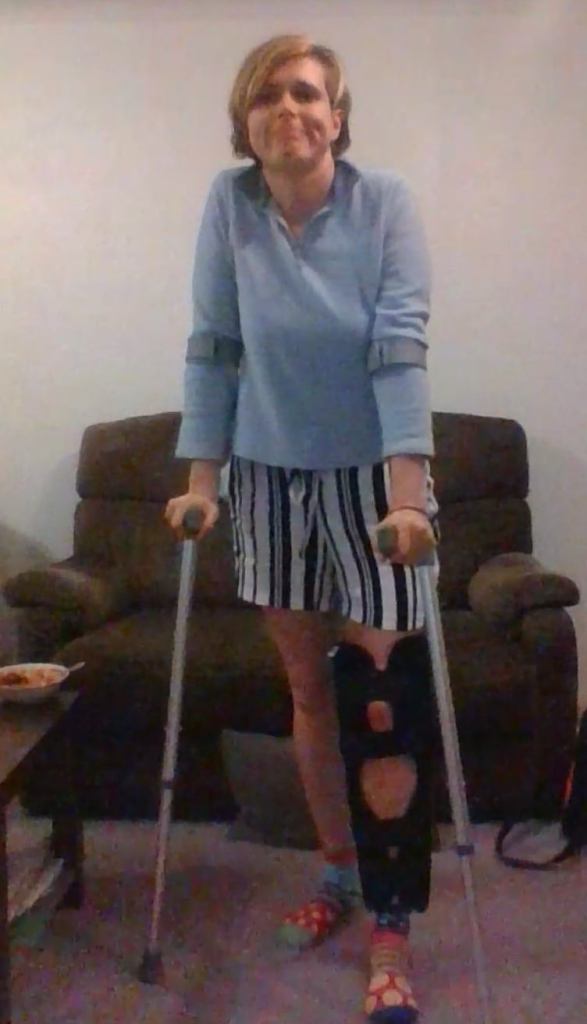
The initial plan was that I would keep the splint on 24/7 for two weeks and then have an appointment at the trauma clinic where the physiotherapist would bend my leg. Under no circumstances was I to bend it myself. Naively I imagined having straightened it for me they would take my leg and bend it back again in much the same way. After a telephone consultation and written correspondence my first appointment was made for four weeks after the accident, meaning an extra two weeks unable to bend and needing to keep it fully elevated at all times (minus getting to the toilet etc). The pain over those first few weeks was horrendous, but with the help of codeine and anti-inflammatories total agony turned to just incredibly painful. At my first trauma appointment I learnt that having not used my leg for so long they could not in fact just bend it for me and we needed to do so a bit at a time. Lying on the hospital bed it reached a pathetic five degrees or so bend. The following week it hit ten degrees.
It is now almost two months since my accident and I am still using the splint for the stairs in my flat (I suspect that will be the case for a while yet) and only have it off walking from one end of my living room to the other a couple of times a day, as well as when stationary and have been warned I will need the crutches for sometime to come. If I shuffle down my bed or across the coffee table I can just about bend it over the edge to the floor but have yet to manage sitting like that for longer than twenty minutes. My next appointment is tomorrow when we are going to start working on sitting in a chair (with crutches) from standing. I have a wedding to go to on Saturday in a church with old wooden pews so this is a must. If I lie on my back and try and move my leg in towards me I am still yet to be able to get my foot flat and the pain in that move has not really got any better.

As for the future? When I first did it, lying on the stretcher in the rink I joked that I would have to go back to watching Torvill and dean videos, as I’d been doing during the closure of the rinks. But I found I couldn’t. Every day over those first weeks I’d scroll passed all those Instagram videos of friends and idols skating away. It was too painful, not just physically (they’d literally make my knee sting) but emotionally. At one point my Mum told me “the best thing you can do is get rid of your skates”, “well that isn’t going to happen” I snapped. In my heart I felt certain the hospital would tell me I could never skate again. That was the real reason I couldn’t watch the videos. Heartbreak. I fell in love with skating (on wheels at first) as a two year old, after fifteen years of neglect I’d fallen in love with it all over again. I’d already wasted years not skating. I wasn’t prepared to loose any more.
When I explained to my physio how it had happened she instantly replied “we need to get you back on the ice”. I should have been delighted. Part of me is, and slowly I have begun to view some of those Instagram videos (those in my class who’ve now reached the dizzy heights of badge 11) but I’m still heartbroken. Knowing deep down that even if I do get back on the ice I’m unlikely to ever feel as free. I need to do lunges to progress. How could I risk it? What if I somehow did risk it and it happened again?
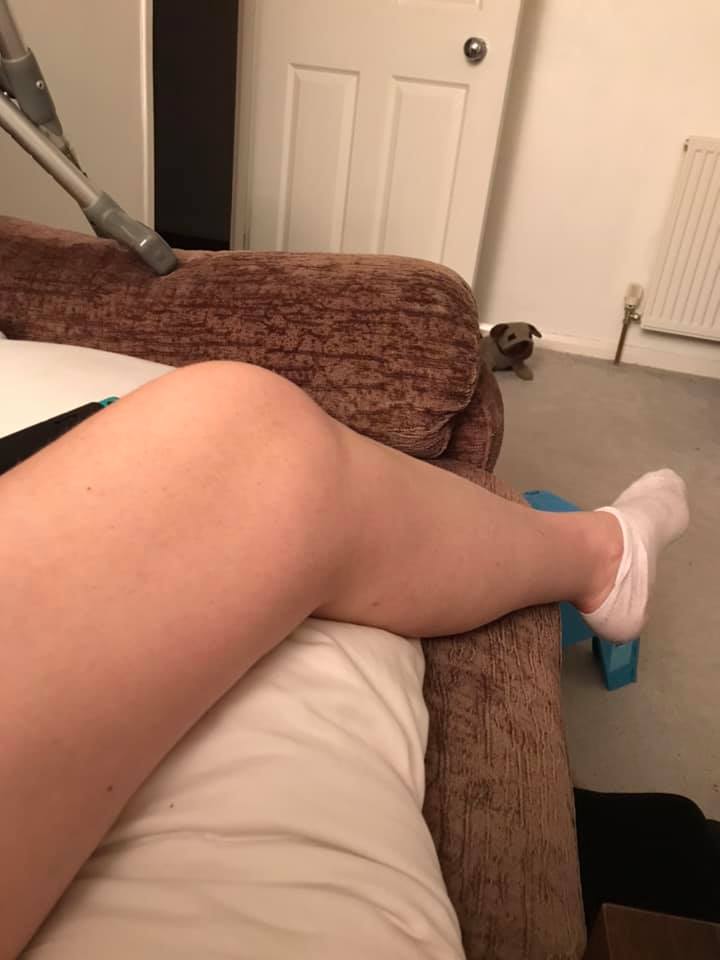
For now I know I need to concentrate on recovery. They say “don’t try and walk before you can run”, well certainly don’t try and skate before you can even sit!
While my learn to skate experience is certainly not the one I signed up for and it may seem hard to believe from what I’ve said, I still wouldn’t change it. How could I? My injury wasn’t caused by my skating. Not really. I didn’t actually do anything wrong. A pre-existing weakness in my knee caused it. Having been born less than six months after Bolero, I’ve spent my entire life dreaming about skating and regardless whether I get back or not I did it. My aim was badge 4 and attempt a forward crossover. I got to badge 5 and backwards crossovers. Right now, I just want to be able to sit in a chair and tearlessly watch Bolero!

 White Skates